Wednesday, April 3, 2013

The Slow Car Movement


The other day I left the shop, admittedly a rare occasion, to pick up a newer BMW coupe from a customers garage about 45 minutes away. As I drove down the road in my older Mercedes diesel sedan I reflected on the humble car that I owned. My daily driver is a mule, it is safe, it gets great fuel mileage, and it weathers the abuse of both time and nature better than most vehicles. My car just passed the 200,000 mile mark and still has all of its original paint on every panel, it is tight and right inside and out. This car was built with good ingredients.

A heavy diesel vehicle is pretty much driven with the accelerator pedal pressed down to the floor. The car needs to be endlessly pushed forward by the driver. When cruising speed is finally reached and the driver lets up on the throttle, the car is sailing. In order to slow down, simply letting off the throttle slows the car rapidly, due to its weight and the aerodynamic forces fighting against the shell of a vehicle that is moving too fast to begin with. The experience of driving this car is one of pushing, and sometimes strangling it into submission. The engine hums loudly, the wind whips past and it feels like point A and point B are as far apart as they really are.

When I arrive to fetch the BMW, it growls to life. I park the Benz in its place and head back to the shop. As I drive my right leg begins to fatigue in a way that is unfamiliar to me. I realize that I am continually, and uncomfortably, holding the throttle back. The car and my gas pedal leg are at odds with one another. The car wants to go a million miles an hour while my leg, thankfully connected to my brain, wants to keep us somewhere around the speed limit. The car is too damn fast. To be honest it starts too fast, turns too fast, goes too fast, and is too fast. And yet the cabin is perfectly silent, filled only with Terry Gross on the radio having a laugh with somebody who knows better.  

But, my leg is tired. Succumbing briefly to the wave of modern convenience and demand has left me wanting. I want to push a car forward, using everything that it has, rather than hold it back from being perfect, predictable and fast.

I've always appreciated the slower path. I want my senses to have time to absorb what is happening. I prefer experiences where my attention and focus is required. These things are more tangible which makes them more memorable.

Drive a slow old car 90 MPH down the interstate and you've accomplished something. You cannot send a text, prepare for an important meeting, or add another chapter to your dissertation. No, you are piloting a relic and are forced to pay attention to the gauges, engine notes, and chassis growls. Your senses are needed and loaded, which is a wonderful feeling.

The evolution of the motor vehicle is impressive, but technological evolution has scrapped some things that are meaningful. The first cars were bulky, slow and guzzled gas as they and rumbled along dirt paths at 15 miles per hour. Today cars are wind cheating cyber lounges that get 40 miles per gallon while racing down the highway. Slow things are trimmed, changed, and usually discarded. They are replaced by faster things, but at what cost? Some important things are left behind.

Weeks later, when I returned for my old Benz it greeted me with a rough plume of unburned diesel fuel. Once again I was having an adventure behind the wheel. My eyes and ears were tuned and sharp, there was no time to think about anything other than my slow car.

Sunday, December 9, 2012

The Toy Shop

Shortly after Thanksgiving we selected a Balsam Fir from the local tree farm down the street. After it was erected and adorned with our antique glass balls and little wooden elves our daughters began to get excited. We then unwraped the old nativity scene and musical silver bells, at which point the girls could not help themselves. While Stella runs around drumming with the glass candy canes, Gina sits quietly arranging an animal take over in Jesus' crib. Suddenly, "uh oh" one of the shepherds and the Rudolph silver bell are down. Our shepherd fell hard, he is getting old after all, the poor guy fractured into 6 pieces.


And this is how I find myself in the shop, on a rainy Sunday afternoon in December, gluing busted silver bells and tending to our unlucky nativity figurines. Every year around the holidays I am reminded of how much our shop has in common with an old toy shop. Everyone carries an affection for toys regardless of their age and when toys are played with, they break. Those broken toys and the Fiat roadster in the bay next to me, which hasn't run since Carter was in office, are here for the same reasons. This season at the shop toys are everywhere, some for little folks and some for big ones. Happy Holidays.

Monday, November 12, 2012

The Hurricane & The Fiat

I grew up in Connecticut and lived for 5 years in Brooklyn, NY.  Recently, as I watched Hurricane Sandy wreak havoc with the Eastern Seaboard my thoughts were of my family and friends in her wake. As the winds died down and the rain stopped I talked to my parents, who had the foresight to install a permanent generator after Hurricane Irene last year, and they were fine. My siblings and their families were getting by without power. My thoughts then turned to one of the regions that was hardest hit, Long Island, NY. This past summer we finished hand building a 1977 Fiat 128 sedan that we lovingly called little Jack. That little Fiat still feels like an old friend, and it's new home was on the coast of Long Island,  right in the cross hairs of the storm. With no word from the owner, due to the wide spread power outage, I feared the worst. Images of the 128 under water or in a collapsed garage haunted my thoughts.


Thankfully, last weekend I received an email with the words I was hoping to hear. We are all okay… and the Fiat is tucked safely away in the garage. Thank god! That little car would be very hard to build a second time. I fear we may have exhausted the remaining stock of spare parts out there to do it once!

Comedians in Cars Getting Coffee

Jerry Seinfeld is well known for being very funny, he is less known for his interest in and depth of knowledge about vintage European cars.

Seinfeld's new web show “Comedians in Cars Getting Coffee” has quickly become one of my all time favorite shows. I appreciate it because Seinfeld so articulately summarizes the experience of driving a particular vintage car at the beginning of each episode. His take on riding around in the old cars that I love and take care of is really unique. First off he’s Jerry Seinfeld. He’s not a bragger, and he’s probably not a boater either. With his characteristic ease, he describes each vehicle in a straightforward manner while also conveying the feeling of the vehicle in a poetic and entertaining way.

I also like that the show is not about the wild world of Mercedes Benz or Porsche. I receive a few of the best automobile publications at my shop. In my opinion, too many of them feature dudes bragging about how much they spent on a caster camber plate for their racer or how little they spent on a paint job in their buddies garage.

The shows premise is refreshingly simple. Jerry picks up one of his comedian buddies in a beautiful old car and they go out for coffee. They talk on the way there, they talk in the restaurant and they talk some more on the ride home. Meanwhile Jerry tells his friend (Alec Baldwin, Super Dave, Ricky Gervais) a bit about the car they’re driving. And he can talk about the size of the engine, he can talk about the vehicles hardware, but he also talks about what makes it unique and memorable.

Check it out on you tube or crackle. It will definitely help you out of your depression.

Just a Lazy Shiftless Bastard - Alec Baldwin - Comedians In Cars Getting Coffee

Sunday, April 22, 2012

Alfa 1900


More than a year ago Ray Reimer and I were driving his Alfa Milano through Amish country in northern Indiana, near his home. Ray wanted to show me his friend Mary’s collection of Ferrari’s in South Bend. We parked outside a small stereo shop in downtown South Bend. There were bars covering the small windows and trash piling up along the sidewalk. Apparently this little shop closed its doors to the public long ago. We knocked on the door and I was introduced to Mary. She was a gruff, spirited little woman who wore an eye patch and swore like a sailor. She and her husband Joe owned and operated the shop until Joe passed away about 10 years ago. The shop was full of miniature Dinky toys, model airplanes, and little metal signs. As we walked toward the back of the shop I noticed that there were cars underneath the memorabilia. I spotted an MG with boxes of vintage toys stacked on its hood, an old Alfa Spider covered in tiny memorabilia, a Mercedes SL peering out from under piles of books. We made our way into a large, clean room in the back of the building. Underneath covers were three Ferrari's, a convertible E type Jaguar, and a really old MG. The cars were all low mileage and had been meticulously cared for.
We pulled the covers off, sat in the cars and chatted about where this collection had come from. It turned out that Mary and her husband had once owned BAT car number 5. They purchased the car in the early 70’s, restored it and showed it. I saw an old picture of Mary standing next to their BAT car at Pebble Beach. When they sold the BAT car they used the money they made, which was considerable, to purchase the collection that we were now admiring.
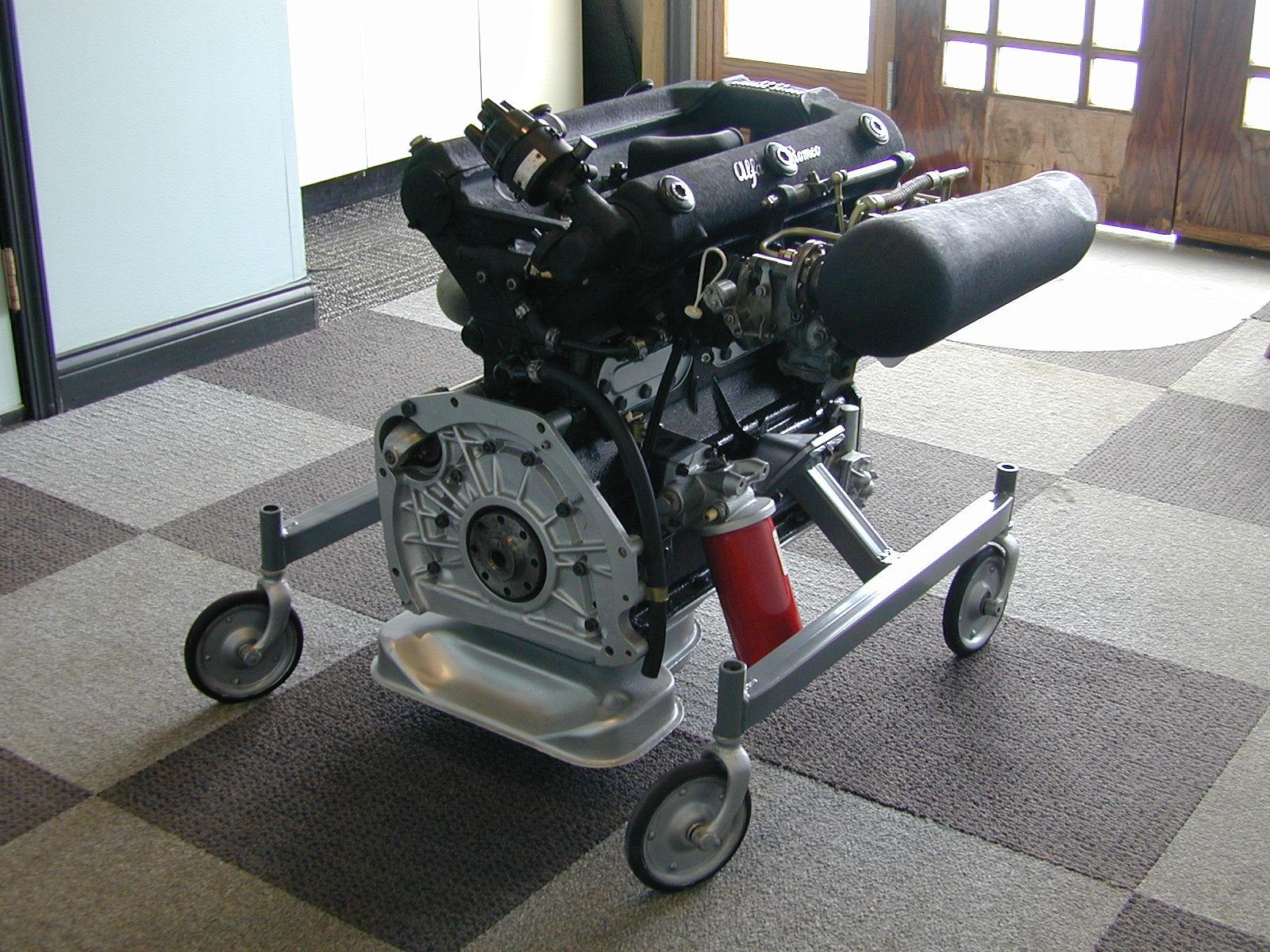
While she was talking about their BAT car Mary pointed to a collection of boxes under an old bed sheet in the corner of the room. It was a post war Alfa 1900 engine that they had wanted to put in their BAT car. The BAT cars were based on the 1900 platform but this engine was slightly larger, they thought that with this engine the BAT car would be a bit faster and potentially more valuable. The engine came from a hand built Alfa Romeo 1900 Spider owned by a friend of theirs. He sold the Alfa engine to Mary and replaced it with a Corvette engine. The Spider was destroyed when the owner attempted to overtake a train. Mary asked me, “You know what happens when you race a train? Train always wins.”
The BAT car was later sold with its original engine, and the 1900 engine was boxed up and forgotten about.

I immediately envisioned this engine restored, put back together and displayed in our shop. Mary promised to sell it to me the next time I was able to visit her. Almost a year later I was back in Mary’s strange little junk shop packing the engine into my truck. I spent many weekends polishing, cleaning, painting and reassembling until the engine looked like new. It now sits on a custom stand in our waiting room, a piece of mechanical history with a very interesting story to tell.  


Tuesday, February 14, 2012

Franz

What a shame. What a tragedy. How can this happen? Recently, during one of my weekend Craigslist quests to save the crumbling orphans out there behind barns and in fields, I stumbled upon a very early W113 Mercedes SL. The Mercedes Pagoda SL's began production in 1964, and this one was a very early 1965 with a manual gear box, European market gauges, and some interesting trim and headlamps not present on US models. After doing a little research I discovered that this was the 458th SL to roll out of the factory. Someone purchased this car overseas and had it shipped to the US a long time ago, back when it was much easier to do so. The gentleman selling the car had purchased it from it's original owner about 10 years ago with the intention to restore it. The car sat in his garage until a couple of years ago when he decided to take the plunge and have the car restored professionally.


Rather than finding a shop that had any type of experience working on a car like this, it was sent to a chop shop in the crumbling industrial district of Benton Harbor, Michigan. The patchwork of buildings were filled with ex-convicts spraying cars in open rooms without respirators on. They apparently specialized in putting 22 inch rims on Chevy Monte Carlos, their pallet of choice included jolly rancher green and metallic purple. When they got their hands on this unlucky SL they ripped the seats out, tore the trim off, and quickly realized they had no business working on a car like this. It was rolled out into an open field behind their shop and left there for over a year. The elements quickly reduced it to a crumbling shell. Most people know that these are very special cars, and to kick one to the curb like this is such a shame.

With difficulty and a heavy heart, I loaded SL #458 onto my trailer and brought it to a place where it can spend it's last days amongst friends. Just out of curiosity, I put a warm battery in it and turned the key. Would you believe it almost started? Perhaps this is not the end of the line for SL #458... only time will tell.

Thursday, November 17, 2011

Decimo Anniversario!

In a couple months we will be celebrating our 10th anniversary. How cool is that? Who would have thought that a restoration shop could survive and prosper in Fennville, and during a recession to boot. It certainly blows my mind!

Ten years ago I started this business in a cold, dimly lit shed that barely fit two cars. I started working on old cars because I had to do something, I was young, idealistic, passionate, and I had just lost my job as a designer. I needed to work on something that inspired me, something that I loved. And I absolutely loved working on those old cars, something about it just excited me gave me energy. With a handful of tools from my college days, and some rusty ones I found on the floor of the shed, European Auto Restoration was born.

A decade later I am amazed that my original idea was actually a kernel that slowly grew into a business which now supports my passion and my family. How wonderful! Currently, we are perfecting our craft. With each project, we improve upon the past. We are doing what we set out to do and finding people who value and support us and our vision.

This winter we are rebuilding a 1750 Alfa Romeo engine, working on a couple of Mercedes-Benz SL's, completely restoring a lovely BMW 2002 and a 1961 finback Mercedes. I couldn't be more proud of the work we are doing and of this unlikely business concept that I have been nurturing for the past ten years.

For me, one of the great lessons I have learned is that a business idea that looks good on paper has no more guarantee of success than an idea that is based on intuition. As an idea, European Auto would have made absolutely no sense on paper, yet here we are. Passion alone is one of the most important ingredients to the survival and success of this business. I have deep reserves of passion and love for the work that I do here and there is nothing else I'd rather be doing. Here's to the next 10 years.

Thursday, September 8, 2011

What happened to July & August?


This summer time is simply flying by and so is our vintage race car! This August at Grattan Raceway our best lap time was 1:32.8 and we came home with a nice 3rd place finish in the Trans Am B sedan race. After Dyno tuning the newly designed race header, we are finally seeing the kind of power expected from #64. Great!


Isabella & Stella came out to visit dad at the track on Saturday
Steve, who has been painting our cars for a few years now, finally took a vacation. Steve is an intense perfectionist and a very particular craftsperson. We had so much going on in the body shop this summer I could see he needed to take a nice break to recharge his batteries. If I didn’t push him out he’d probably muscle through the work load. But, good work happens in a clear and calm state of mind, and everybody needs time off.

And in the shop... the Adenauer is undergoing extensive road testing after it’s re-awakening and we are getting close to sending ‘the Chancellor’ home. A bunch of sheet metal just showed up here from Stuttgart for Molly, our current rotisserie project. The little Fiat 128 is back on the hoist for more assembly. What a beautiful car, I can’t keep from staring at it. We are planning on hosting our 3rd annual driving tour on Saturday, October 15th. Here’s hoping time will slow down a bit for us to enjoy all the great cars that roll through here.


Saturday, July 9, 2011

The birthday present

My father is a soft-spoken man of very few words. Growing up, my mother did most of the talking in our household, while Pop taught my siblings and I by example. He worked hard, sent us all to college, built us each a beautiful kitchen, along with numerous bedroom sets, bookcases and bathroom armoires. He never asked for anything in return, and usually adamantly insisted that we give him nothing. This selfless part of his character was a hard pill to swallow, we all felt a bit guilty taking from the man over and over again.

Two years ago I spoke with my Mother about my Fathers upcoming 60th birthday and his retirement plans. They had recently talked about what he wanted to do to celebrate the end of a lifetime of working hard every day. He replied that he wanted to build and race a vintage race car, specifically he wanted a 1750 Alfa Romeo GTV and he wanted to build it at our shop here in Michigan. My mother wanted to make his dream a reality, so along with giving the whole idea her blessing she gave me a budget and told me to start looking for the perfect car to surprise him with on his 60th birthday. In the end, I didn’t find a run of the mill, tattered Alfa GTV. I found a 1971 GTV 1750, one of the most collectable GTV’s on the market. It was for sale right here in Grand Rapids, and I picked it up for a little less than we had discussed spending.


This June, we celebrated Pop’s 60th birthday with the entire Michele family, here in Michigan. We closed the shop early that day, and assembled with appetizers and birthday cheer on the patio. Everyone followed me down to the body shop, where I was supposedly headed to show off our latest restoration projects and new paint system. Pop was right at my heels, unaware of what awaited him in the shop but truly excited to spend the evening amongst old cars and family.


I swung open the large overhead door revealing the GTV sitting under a banner that read “Happy 60th Birthday!” Pop looked at the car, looked back at his entire family gathered together and then buried his face in his hands and wept. My family and I looked at each other nervously while the children excitedly chased each other around the shop. After a few long minutes Pop cleared his throat and quietly said, “It’s so beautiful”.


It was one of the greatest moments of my life. I have been looking for a way to show Pop my gratitude for a very long time.

Friday, May 27, 2011

Exciting times in the month of May

On May 1st our Alfetta finished 10th out of 39 in the first vintage race of the season at Gingerman Raceway in South Haven. First would have been better, but all in good time.


Our second daughter, Stella, was born on May 14th at 1:46 am. She came along so quickly I almost had to deliver her myself in the front seat of our old Mercedes. We made it to the hospital just in time, thanks to a bit of adrenaline fueled, spirited driving.


Cars keep piling up around the shop… we certainly have our work cut out for us this spring. I just finished installing a clutch in a lovely original owner Fiat Spider. A great looking 560 SL from Florida with a sunbaked interior awaits interior restoration. A late Alfa spider is hiding some elusive Motronic issues. The INKA BMW is being prepared for the season. The 52’ Mercedes Adenauer is under going extensive mechanical restoration, what a beast! Then there’s the Mercedes Sprinter in need of a replacement piston (#2). An S class needs a head gasket, and an old W108 chassis showed up last week on a flat bed. That poor car has the saddest look on her face, but I told her “don’t worry old girl, you’re amongst friends here”. The Fiat 128 just came off the rotisserie, and the 61’ Benz is a day away from mounting up. Sprinkled in the mix are a super low mileage BMW Z3, an 82’ Mercedes diesel wagon, a Rover county that just arrived here from NYC and a 67’ Mercedes SL hiding in the body shop somewhere. My god, Stella will be in high school before I clear up all these projects.


Wednesday, April 13, 2011

The Parrot

Folks, we have Glasurit!


Early this spring we had a complete Glasurit 90 line installed in our body shop. This is the next step towards having complete artistic control over the work that comes through here. Now we make all of our paint right here. We make the primers, sealers, bases and clears that adorn these rolling works of art.

Gone are the days of chasing down an obscure paint code for a car few remember. Gone are the days of convincing a paint supply store to give a damn about perfectly matching the color that was on a car. Gone are the days of using paint that, quite frankly, is second best.

Glasurit was formed in Hamburg, Germany by Max Winklemann in 1888, marking this year as their 123rd anniversary.  They are and have always been known for making the best tints in the world. Glasurit is the absolute best automotive paint on the market and is almost exclusively used on most of the European brands that we work on.

Your BMW came from the factory with Glasurit.
Your Ferrari came out of the factory with Glasurit.
Your Mercedes emerged from Stuttgart with Glasurit paint.
Your Porsche, your Fiat, your Alfa, your Saab, your Volvo, your Bently, your Volkswagen…

Glasurit’s new 90 line is also the most eco friendly automotive paint currently on the market. Basically, the 90 line sandwiches urethane with water based color pigments, greatly reducing the heavy metals that were once standard in all automotive paint.

We love using only the best ingredients, and we spray Glasurit.


Monday, February 28, 2011

Carlo's Pipe Organ

I am building a pipe organ. A collection of tubes, created with a specific length and diameter. Pipes designed to direct sound pulses from one place to another in a most pleasant way. The sound pulses must move quickly from the cylinder head of our race engine to the exit on the left side of the car.


If done properly we will be deliciously rewarded with increased power and a sound that only a purebred can produce. If done improperly I will be thoroughly depressed and probably never return to this terrible place. I wouldn’t be able to stomach the smell of oil burning off mild steel as the TIG welder migrates in a zig zag pattern across the seams. Too many hours spent reading boring engineering journals. Too many hours drawing full scale sketches. To many hours cutting and welding, cutting and welding again.

But, on paper this should work. It should be great. In theory these pipes should be a great improvement over what once was, a pipe organ that sounded like an out-of-tune bat. And that tone def bat was robbing horsepower from our small Italian heart.

Austrian born Carlo Abarth got his start hand building race headers for tiny Fiats decades ago. He sensitively manipulated steel pipes until they were able to sing a song so beautiful that everyone had to have one of his headers. It seems that he had a talent for romancing exhaust gasses away from the minature race engines that he tuned. I feel as though there may be a little bit of Carlo at work right here in Fennville. We’ll find out in May.

Monday, January 24, 2011

Number sixty four

I love the winter time. It slows down here a bit. It allows us the time to stop, look around and repair our tools, tend to the neglected areas in the shop and make improvements to systems.

It is also time for our shop race car to come inside for dismantle, inspection and improvement. We campaign this car for a number of reasons, probably the most important being an opportunity for us to improve our craft. We test lubricants, materials and ideas on our vintage racer. We test our skills in graphics and appearance. We test the limits to structural integrity as we modify this nearly 40 year old car. What a wonderful way to break things. It is also a wonderful time to be creative as hell. Why did this break? What is strong what is weak? I have to admit here that this part is probably more fun than driving this raspy old police car.

Alfa Romeo began to develop the Alfetta as a race car shortly after it debuted in 1972. They raced a half season with very good results but unfortunately Alfa Romeo pulled the plug on their racing program due to the company's pending bankruptcy. This winter we have been busy studying photographs, like the two above, from this aborted racing effort to glean some sense of what plans and improvements Alfa may have had for this car.

This winter we began our improvements with a new hand made aluminum valance designed to improve the way air moves around the car body. During this modification we also decided to move the oil cooler to a more attractive position. The chassis was lowered to a point where the car was experiencing some wicked bump steer, so the front hubs were removed and reconfigured.

And then there's the trunk. The trunk was fine, I swear. But I had been dreaming of ripping it apart and making better sense of it. The trunk was a heavy, soft lump that was along for the ride. We shed 100 pounds back there at the same time made the suspension and body far more rigid. The fuel cell was also relocated to a more attractive spot.


At this point we have just enough time to freshen the cylinder head and design a racing header appropriate for our robust engine.

Needless to say this is no mail order race car considering our aspirations. We plan on setting aside many weeks each year to dream, invent, and build until the cloud of metal dust has cleared. Then we race, we break it, the snow falls and everything slows down. What a wonderful time indeed.

Tuesday, December 21, 2010

Giuseppina Matarazzo

Giuseppina Matarazzo was my god mother. I've known her since before I can remember. She and my godfather Paolo were from Sicily and they spoke only a few words of english. She used to take me fishing as a child. We would drive about an hour from home to their cottage in Clinton, CT. Paolo would stay home painting landscapes in oil while Giuseppina and I sat together silently for hours on the rocks fishing. After our afternoon of fishing we would gather up what we had caught and bring it back to the cottage where she would clean it and serve up some delicious Sicilian meal. Although we'd say very little to one another I knew she was fond of me, I could just tell. Those were magical summers spent largely in silence. When the week end ended, they'd drive me back home.

Giuseppina was an excellent seamstress and ran a small dress making shop in Hartford, CT. Recently, she passed away with cancer and Paolo followed soon after her. They were great people. A few weeks ago I received Giuseppina's industrial Singer sewing machine. Although it is over 100 years old it was her main gun, her preferred gun. Now that I've fired it up I can begin to understand why. What a sweet old machine. Fast, quiet, useful and powerful! It is one nasty machine. I'll bet this thing can sew sheet metal together. Who needs a MIG welder!

One of the things we have limited control over is the welding of leather and vinyl, sewing. We rely on other people to take care of this for us because we are not set up to handle the task...until now. Its all about control. Absolute control. Failure can always be chucked up to someone else's lack of standards. Someone who simply doesn't care. I want control over the final product not only because I love what I make but also because I have to face the person who is going to pay for and live with my work. I have to look them in the eye and tell them that this is as good as it gets.

Our antique Singer was Giuseppina's machine, and now its has arrived here so that we can continue to do great things with it. Giuseppina has helped me gain control over a once elusive part of my craft, which I feel is an important thing when you are trying to create something memorable. I hope she knows how grateful I am.

Friday, December 3, 2010

Pelle

Pelle, a red 1967 SAAB 96, recently spent a few months here at the shop. And I have to say, Pelle is one of the most memorable cars I've ever had the pleasure of knowing.

I get to work with so many great cars, Alfas, Mercedes, BMWs, Fiats. I'm no stranger to exotic and lust worthy relics on four wheels. But Pelle really surprised me, this little car is a commoner, a blue collar worker, a simple car. But my god, it has more personality than all of the cars in Yokohama (or wherever it is that they build Subarus) combined.

Pelle is a rally champ. A car that snorts reliably at you. A car whose pedals are awkwardly off-center, but make perfect sense. It is the only car we've had through here that actually has a wider track up front than in the rear, meaning that Pelle has a fat nose and a skinny butt. Pelle was imported by its current owner from the arctic circle in Sweden and that car drives like a miniture Swedish tank. With a 4 speed on-the-column shift, quick jerky revs. and the smallest windshield you've ever looked out of Pelle is memorable.

Art, Steve, and I did a considerable amount of work to this old car. We lovingly put it back together, addressing all of the strange issues that so often turn up after years of being incomplete. It was a wonderful experience. When Pelle was finally ready to leave our shop we were all a bit sad, myself especially. I really enjoyed driving that car around and around. When the owner asked if Pelle was ready to come home yet I replied - she's ready, but I'm not.

Bella Berlina

I have a beautiful 1972 Alfa Romeo Berlina that is waiting for someone to fall in love with it. This car is currently and unfortunately painted gold, but her original color was eggplant, and to my eyes it is one of the sexiest colors that has ever been draped upon an automobile. 

This is the kind of car you'd see Elga Andersen driving recklessly down a bustling city street towards some unknown tragedy. Someone she loves, no doubt, is in peril. She speeds along, her big head wrapped in a flowing scarf, in an eggplant colored Alfa Romeo with a limited slip differential and a mahogany dash. My god!

I am patiently waiting for the day when I meet the right person, the one who wants to love and take care of my old girl. I am waiting for someone who wants to remove her putrid gold latex exterior and reveal her luscious eggplant as desperately as I do.

Wednesday, November 17, 2010

Chef de rouille

In describing the work that we do to someone inquiring about their car, cars in general, an ongoing project or a dream, I often compare our shop to a kitchen. It is one of my favorite analogies. I see our shop as a turn of the century european kitchen serving up delicious mechanical experiences.

In our kitchen I am the chef de cuisine literally the 'chief of the kitchen'. I am responsible for the management of my kitchen, supervising staff, creating menus and new recipes, making purchases, and maintaining a sanitary and hygienic environment for the preparation of mechanical art. Steve is my saucier, a highly respected member of our kitchen brigade. Arthur would be the cuisiner, occupying an independent position preparing specific dishes on his station. And Juliet is our front of the house manager.

In our kitchen we use only the best ingredients available. If you ordered a Mercedes-Benz of any vintage the factory is probably still making any part you need. If not there is a good alternative to be found or fabricated. Our kitchen is clean, you may not want to eat off the floor but you can actually find stuff in here. Our kitchen is run with discipline and focus. We believe that allowing ourselves the time and space to carefully dismantle and reassemble complex components, solve problems, or follow through with ideas is crucial.

The swinging door that separates our waiting room from our workshop was once the door to a restaurant kitchen. With the word 'Kitchen' painted in green and gold block letters below a small glass window the door reminds me of a line drawn in the sand between patrons and crafts people. Beyond the kitchen door artisans work their magic and chefs become famous.

As romantic as my favorite analogy is I am troubled by how it fails to describe the true nature of our business. Unlike a restaurant our menu has been written for us. It was written many years ago and much of it has been lost or is unreadable.

What if Mario Batali or Lidia Bastianich couldn't do one of their cooking shows until someone from the audience flung them a neglected pork chop with freezer burn and a couple of rotten endives out of the crisper.

Maybe we are in a truly unique situation here. We take a large and very complex mechanical organism fraught with cancer, electrical glitches, dents, scrapes, leaking, smoking, stalling, and shaking. We pour our energy into the vehicle and its owner, attempting to mend each of them.

We talk about what we do in culinary terms as we struggle in vain to build a time machine. Perhaps we are better described as therapists, trying to decode the vehicles that we work with and in turn help their families understand and accept them as the beautiful, flawed objects that they are.

I still like the chef part best.

Wednesday, November 10, 2010

It is not about the tools

I love tools. Big tools, small tools, tools that take a crew to install, tools that are as relevant today as they were a century ago. From bullet proof German brands like Stahl-Wille and Hazet, to brands still made in the USA like Snap-On, Mac and Craftsman, I love tools. For measuring close tolerances there is even a place in my heart for the Japanese brand Mitutoyo.

Other shops and dealerships often impress me with their tooling. I find myself scanning their inventory and calculating the tooling expenditures as if I were working for the IRS. Snap-On cabinets neatly filled with Snap-On everything, Nussbaum auto lifts, a complete Hazet tooling set-up. Some shops give the impression that without their special edition Nascar Snap-On tool wall a job will simply not get done properly.

As much as I envy the professional, homogeneous tooling set-up, I wonder if it has an adverse effect on creativity. When I go for a 17mm open end wrench to crack virtually any nut on a Mercedes-Benz, I use the same Craftsman wrench my mother gave me for Christmas when I was 18 years old. It was available at the Sears in the mall, It was affordable, and it is a damn good wrench. It does the thing I need it to do every time. And somewhere in this shop, in a mismatched tool box from a big box store, or an old metal tool box, or even an oil stained wooden cabinet, I can still find that old 17mm wrench. A wrench that lives among relics from the past, gifts from family members, specialty tools created for a singular purpose and the 'professional' tools that I now justify investing in.

I think that our shop thrives in a place where the past is revered in the same heartbeat in which the future is embraced. Like a family farmhouse where relics of the past share space with beacons of the future, we are surrounded by our own mechanical heirlooms and technological marvels.

Friday, October 29, 2010

Datsun 240Z Photo Shoot

Pulling the plug

Today we encountered a very familiar dilemma. A moment where logic wins the ongoing debate with the heart. We come to these crossroads so often because logic makes sense, and sense is good. But what of the heart?

We decided to disable a system inside a vehicle, a system that was not vital to the cars drive ability. Needing significant repair, and a bit expensive really, the system was determined unnecessary and unplugged.

But I must admit, something important seems to be lost in the integrity of a vehicle when sacrifices based on budget alone are made. The vehicle is still perfectly usable, but perhaps the door has been opened through which doubt and mistrust may enter into the owners relationship with their car.